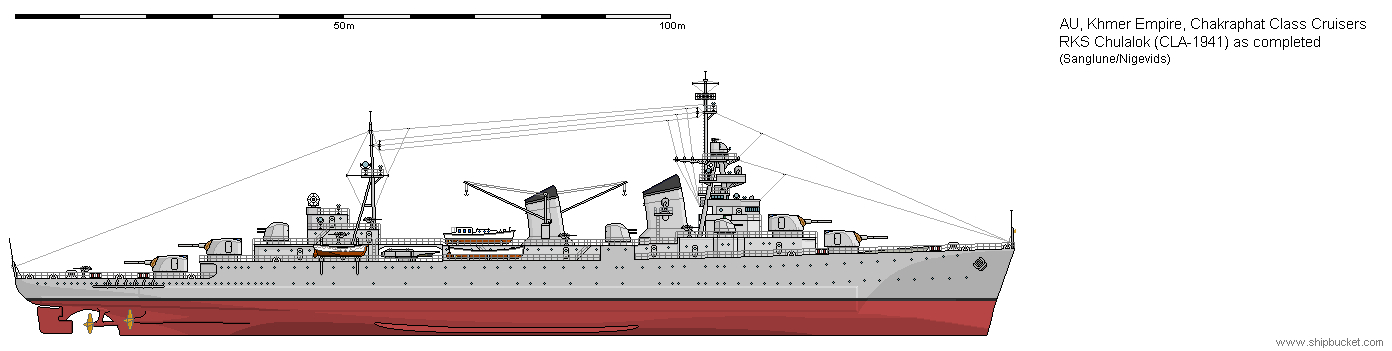
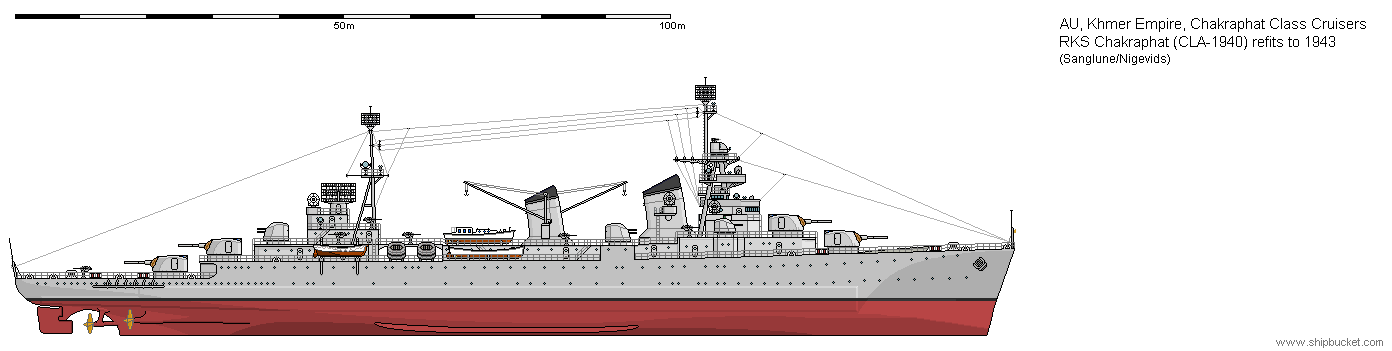
These nine ships were the wartime building of cruisers for the Khmer Navy. The three laid down in 1940 did not complete till late 1942 to early 1943, the 1941 ships did not complete till 1944-45. Production on the ships slowed down as higher priority work was put in front of them. Repair work to existing ships was an ongoing high priority. The completed ships were worked very hard. They had continual upgrades to the original fittings as shown above. The first 40mm radar predictor was fitted to the Chulalok just prior to its completion in March 1941. Space for further predictors for the other 40mm mountings was found as they became available. More Radar of all types were mounted through the war, the torpedoes being removed in 1942 to offset some of the added topweight.
Khmer started going to a war economy in 1937, when the Japanese attacked China. It was obvious the Japanese were after resources. Khmer knew that their resources, rubber, oil, iron, etc were high on the Japanese list for acquiring. The northern border with China was garrisoned heavily with layers of troops covering the most important areas. The three major ports and Palembang, for the oil, were heavily fortified. The High Command and Rulers of Khmer debated whether to resist Japan or join them. The Japanese atrocities in China showed what could happen if the Japanese took Khmer by force. Khmer knew that it could not hope to hold off the Japanese by itself, it could only survive if it could join with the Allied forces if Japan attacked them as well. 1940-41, Khmer watched the US tariffs on Japan bite deeper and deeper. Japan was ready to break. War was imminent.
Sunday the 7th of December, 1941, will live on in infamy as the Japanese attack on Pearl Harbour occurs with no prior declaration of war. The Pacific Fleet battleships take a hammering, many are sunk. Much damage is done to infrastructure. Pearl Harbour is a mess but not out of the battle for long. The miracle of Pearl takes place where half of the battleships are raised and sent to Stateside ports for major refits and rebuilding. They would become the shore bombardment vessels and give back to the Japanese in high explosives. But where were the US carriers? Many thoughts have been given that the US High Command had foreknowledge of the Japanese attack and sacrificed the battleships to save the carriers. The US carriers of the Pacific Fleet were south of Hawaii, with their escorts, and out of sight of the Japanese. The sending of the available US forces to chase the Japanese Fleet that attacked Hawaii was a gesture to appease the masses. No way did the CincPac Admiral want his ships to attack an enemy that was twice their size. Lose the carriers and the war would be lost. The time to fight back would come soon enough.
The Japanese attacked on a broad front with attacks on the Philippines, and the Dutch East Indies being carried out. On the 8th of December, Japanese troops attacked into Khmer. Khmer had not been given the option to join, the Japanese would try to take what they wanted. The Japanese made only slow progress, their troops were not as good as the Khmer Army fighting in its own back yard. The Khmer aircraft were as good as the Japanese. The Latecore, Breguet and Dewoitine aircraft were first class and helped stop the Japanese advances in their tracks. The Japanese used their tanks only to find the Khmer/French tanks were just as good, and set in tank traps, killed many Japanese.
The Khmer Navy made its name intercepting the Japanese cruiser forces guarding the troop ships headed for Borneo and south. The Japanese carriers were still on their way back from Pearl Harbour and were cursing the High Command for attacking Khmer without naval support from Nagumo's carriers. The main Khmer Fleet with four carriers, and supporting battleships and cruisers, caught the Japanese convoys in the South China Sea. Of the two battlecruisers, eight heavy and four light cruisers, twenty destroyers, and seven troop ships that started out, very little got to return to base. The Latecore bombers, with the Dewoitine fighter support, made the troop ships the priority and sank all seven. Those aircraft, that had ordnance left, attacked targets of opportunity. One battlecruiser was torpedoed and slowed dramatically. Two of the heavy cruisers were bombed and slowed while fighting major fires. Other ships were also damaged and the 'cripples' banded together to head north. The remaining undamaged ships headed north at 30 knots to try and escape. The Khmer Fleet was in hot pursuit making 25 knots with the Fleet having to swing to the wind to land on and launch aircraft. A second strike of surviving aircraft was ranged on the carriers was launched in the hope that it would catch the Japanese Fleet before it could get out of range. The Flight Commander could see the Japanese on the horizon with his aircraft only having 30-35 minutes of combat fuel left. They would have one pass to inflict damage then have to return to the carriers.
One pass was enough. The second battle cruiser was crippled along with another two heavy cruisers, a light cruiser and four destroyers. What was left raced north at 30 plus knots to get themselves into friendly air coverage range before the Khmer Fleet could finish them off.
The first set of cripples were caught by the Fleet before dark. The two Loethai class battleships made short work of the Kongo, which had no answer or armour to fight against the 16" shells that tore it apart. But one of the other two battleships in the fleet received major damage from 24" torpedo hits. This was the first time Khmer had come up against the Long Lance and two other ships were sunk and another damaged before the last of the crippled Japanese ships was sunk. Those damaged ships went to Indrapura for repair.
The Khmer Navy was now wary of getting to close to the second lot of cripples because of the unknown capabilities of the Japanese torpedo. One of the second group of cripples was forced ashore and abandoned, scuttling charges destroyed most of the ship, but a salvage group off one of the Khmer cruisers grabbed two 24" torpedoes which were to be examined back at base. The second group of cripples were sunk by air attack the next day.
The Khmer High Command could do the math's for themselves. It would take the Japanese Fleet a week to return to Japan. Refuel and rearm then another 4-5 days before it could head south for Khmer and other targets. Khmer had a week, after destroying the Japanese invasion forces, to plan for the overwhelming response expected from the Japanese Navy. The Japanese had twice as many effective carriers, most of which carried more aircraft than the four main Khmer carriers. The Khmer ships, even if they were able to keep close enough to Khmer to get land aircraft support, would still be seriously outnumbered. The US Fleet was half the Pacific away and would not be available to help. The only US ships still in South East Asia were three cruisers and a squadron of four piper destroyers. Those ships were in Java with surviving Dutch ships. All that was left from the forces at the Philippines. The submarines that had been based there were withdrawn back to Hawaii. The Australis forces, with a pair of Royal Navy cruisers, were based on Darwin and they could join the forces at Java when needed. It would take some time before the Australis major capital ships could be disengaged from the Mediterannean and returned to Australis waters. There were only two carriers anywhere near to Khmer that could have joined the fleet. The old HMS Hermes was at Ceylon, and the HMAS Carpentaria at Darwin. Both ships were WW1 vintage and carried less than 20 aircraft. The Hermes had been hunting German raiders in the Indian Ocean, while the Carpentaria was the training carrier for Australis. Neither ship was deemed useful enough to go to Khmer's aid. They would take weeks to integrate together. The Khmer had days.
Khmer had two choices, a glorious death to its fleet as it was mauled and torn apart by the Japanese Fleet, or run and hide to fight again another day. They chose, RUN. The four carriers would land their aircraft at each of the four major ports to help strengthen the aircraft units, then the main Fleet would head for the Persian Gulf. What the Fleet would leave behind was its four submarine squadrons in the choke points to Khmer, where massed submarine attacks could take place. Copying the German 'Wolf Pack' tactics. It was felt that an attack on each of the four main ports would reduce the effectiveness of the Japanese air wing as losses would mount from each attack. These aircraft would be carrying the cream of the Japanese pilots. Each one lost was irreplaceable to the Japanese.
Having sunk the Japanese invasion transports, five divisions of crack troops, the Japanese would somehow have to find replacement units to be used for the taking of Borneo, Java, Sumatra, and other islands that could help supply the Japanese need for resources. Those transports would be the prime target for the submarines and aircraft. Sink those and Khmer would remain free of the Japanese. During this period of three weeks, the Khmer Army Group North was more than holding the Japanese. The Khmer had been building fortifications in the northern border regions for over a thousand years, these fortifications were aimed at the Chinese but worked just as well against the Japanese invader. Japanese Banzai attacks failed to break through in any depth into the Khmer lines. Those incursions would be attacked by the Khmer reserve divisions and tanks held behind the lines for just that eventuality. The Japanese could only muster a further three divisions of new, barely trained troops, for the invasion work. The Japanese had to reduce its target list to only the most essential - resources. The plan to land troops on the coast of Khmer to break open that front could not be done with the forces available. The best troops were in China fighting against Khmer and the Commonwealth forces in Burma and toward India. Those troops could not be withdrawn, they were fully engaged. Only a few weeks into the Asian War and the Japanese were getting over extended. They had been fighting in China since 1937 and had still not fully subdued China 4 1/2 years later when they opened two new fronts against the US, the current Allied forces and Khmer which also joined the Allies, any setback had a disastrous effect further down the track.
The Japanese were forced to try and achieve too much with too little. They may have had the premiere Carrier Division under Admiral Nagumo, but it was only at its best when it could field its full eight carriers against single targets. The Khmer winning the Battle of the South China Sea had not been in the plans. The High Command wanted the resources that its war machine needed to survive and prosper, risks would have to be taken to achieve those goals. The Japanese were forced to split their carriers with two fleet carriers, one light fleet carrier with one division to subdue the Solomon Islands and start to take New Guinea. Follow up forces would be sent as soon as they could be raised. Unknown to the Japanese, the first Australis large carrier, HMS Endeavour had just finished working up its air group and was ready for deployment. The US Navy had heard of the Japanese split and sent the Lexington and Yorktown to act with the Endeavour in intercepting the Japanese forces - leading to the Battle of the Coral Sea. Both Zuikaku, and Shokaku took heavy damage and would be out of action for six months. The Shoho was sunk. The US lost the Lexington and took damage to the Yorktown. The Endeavour was undamaged and escorted the Yorktown back to Pearl Harbour for its hurried repairs. Those two would join the Enterprise and Valley Forge to head for Midway.
The other six Japanese carriers rampaged through the South China Sea taking air superiority wherever it went. But, as predicted, the Japanese wanted to send Khmer back to the Stone Age, with attacks on each of the four main ports with a follow up landing on Sumatra aimed at taking Palembang. Khmer's plan, of reducing Japanese effectiveness, attack by attack, worked. By the time the Japanese attacked Palembang it was almost a halved fight. The Japanese landed their troops which then attacked the Palembang Garrison which was big enough to repulse the Japanese attacks aided by the guns from the old ships anchored in the harbour. Admiral Nagumo was getting seriously worried about the losses of aircraft his fleet were taking. His Fleet was being harried by attacks from Khmer aircraft. Two of his four troopships had been sunk and other ships had received torpedo damage from the Wolf Pack night attacks. Nagumo was forced to withdraw his Fleet back to Japan. Of his six fleet carriers, two had received torpedo damage and would be out of action for four to six months. The aircraft remaining from those ships were transferred to the four fully effective carriers. Two new light carriers were added to the Air Carrier Fleet to bring it back to six, but the light carriers only had half the complement of aircraft. Khmer defeated the attempt to take Sumatra/Palembang and three months later retook Borneo. Of Japans December attacks - only the Philippines was still held by the Japanese.
The only part of the Japanese plans that came off was the taking of the Solomon Islands and landings on New Guinea. They failed to take Port Moresby which Australis used for supplying its troops via the Kokoda trail to keep bleeding the Japanese of forces, a bitter struggle in horrible conditions. The US also took a hand in the Solomon Islands, landing on Guadalcanal and capturing the new airfield then named Henderson Field. This also led to a long bitterly fought campaign that bled Japanese forces trying to resupply its troops and retake Henderson Field. Naval Battles occurred almost nightly with short ranged actions between cruisers and destroyers then culminating in a couple of actions where battleships and battlecruisers slugged it out at short range. The US and Australis forces may have come out on top but the losses of materiel to both sides was horrendous. But the Allies could replace their losses, the Japanese could not.
The loss of forces during this time meant that when the Japanese decided on their next move against Midway, their carrier forces had been badly reduced in effectiveness. No longer was it the well drilled machine. Too many rookie pilots now populated the carrier squadrons. Midway proved decisive with five out of six Japanese carriers being lost with only one US carrier being sunk. The Japanese would never again be able to field a carrier force that could challenge the Allied Fleets that would soon do their own rampaging across the Pacific. Khmer had played its part in bleeding the Japanese to the point where the Japanese became vulnerable. The Northern border became a static struggle like the trench warfare of WW1. Massed forces eventually broke the Japanese forces and headed to encircle the Japanese forces in Burma and the Indian borders. The Japanese were forced to withdraw again.
Khmer did not come out smelling of roses. The winning of the various battles took huge amounts of men and materiel losses to Khmer. The attack on Indrapura sank the damaged battleship and several other ships. Damage to infrastructure was heavy. Indrapura was the worst hit but its air units did their job almost to the last aircraft. The Dewoitine fighters were a nasty surprise to the Japanese and did very well against the Zeros and other carrier aircraft. The Latecore bombers sank one of the transports and the other was sunk by submarine. The Khmer forces harried the Japanese and did enough to force Nagumo to retire and abandon the troops on Sumatra and Borneo. The fleet returned from the Persian Gulf after Nagumo's withdrawal. But it would be some months before enough pilots could be trained to replace the losses against the Japanese. Enough pilots and aircraft were available to man one carrier and that was the main attack force when used against the Japanese troops on Borneo.
Those first six months of war against the Japanese was a war of attrition, a war the Japanese could not win. It would take years more to force the Japanese to finally surrender but the writing was on the wall after Midway. From then on the Japanese were entirely on the defensive. The odd counter-attack was made but ended in disaster with more ships and men being sacrificed.
Khmer had done well to survive. Would Khmer have joined the Japanese if they had been offered the chance?
I might try a write-up from that point of view in one of the next pages.