The Lemurian Navy was slow to build ships in comparison to the Royal Navy. Lemuria completed its three Dreadnoughts, while at the same time the RN had completed 16 Dreadnoughts and Dreadnought Cruisers. Lemuria missed the Neptune and Orion classes entirely. The next class the Lemurian Navy undertook to build was two of the King George V class battleships.
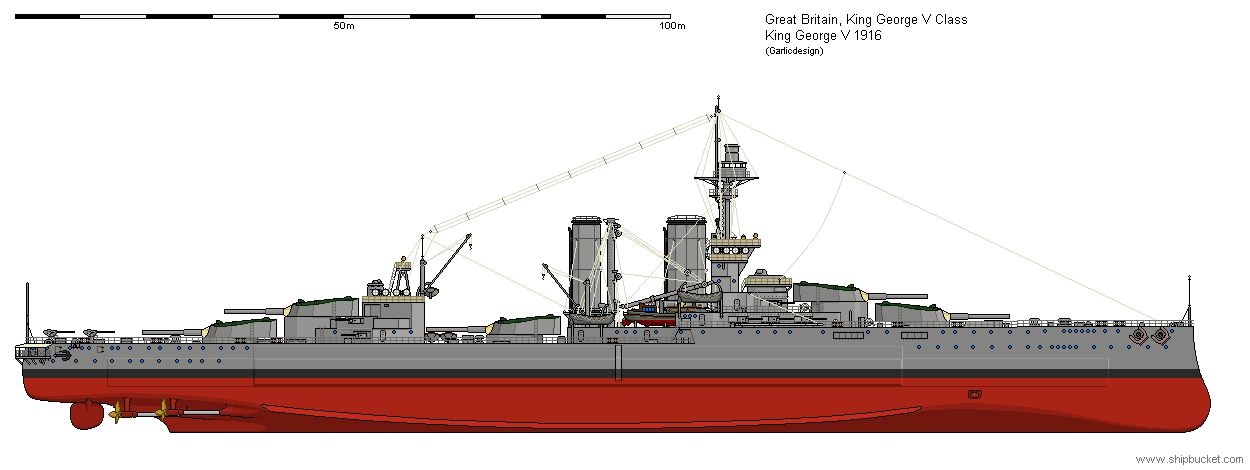
The Lemurian designers had now built three Dreadnoughts. Two Queen Rangita at 21 knots, and one Andrianerinerina at 26 knots. Using those three ships highlighted one thing. If the main Fleet units were to be based at Donbon then sent to whichever part of Lemuria required assistance, the 21 knot 'Fleet' speed ships were really to slow. What was needed was a fast battleship. At the same time as the KGV design was received the design for the Lion Class Battlecruisers also came in. While the Lion design, on paper, would do everything Lemuria wanted, it was lightly built and armoured, but fast. Strike three was the Lion had the Mk.1 13.5" guns firing the lighter 1200lb shell, the KGV the Mk.2 weapons firing the 1400lb shells. Also the layout of the Lion's 13.5" were not optimal with the Q turret design. While the KGV design also had the Q turret it was felt that the Q turret removal would provide the space required to increase the speed of the ship to the 26-27 knots required for fleet flexibility. The next thing the Lemurian designers had to look at was hull hydronomics - how to make the hull faster. Pouring machinery power into the hull would make it go faster but would be quite wasteful of the horsepower available. The easiest way to achieve that was to alter the length to breadth ratio by lengthening the hull. The bow shape was also not conducive to achieving a better hull speed. A change would be made.
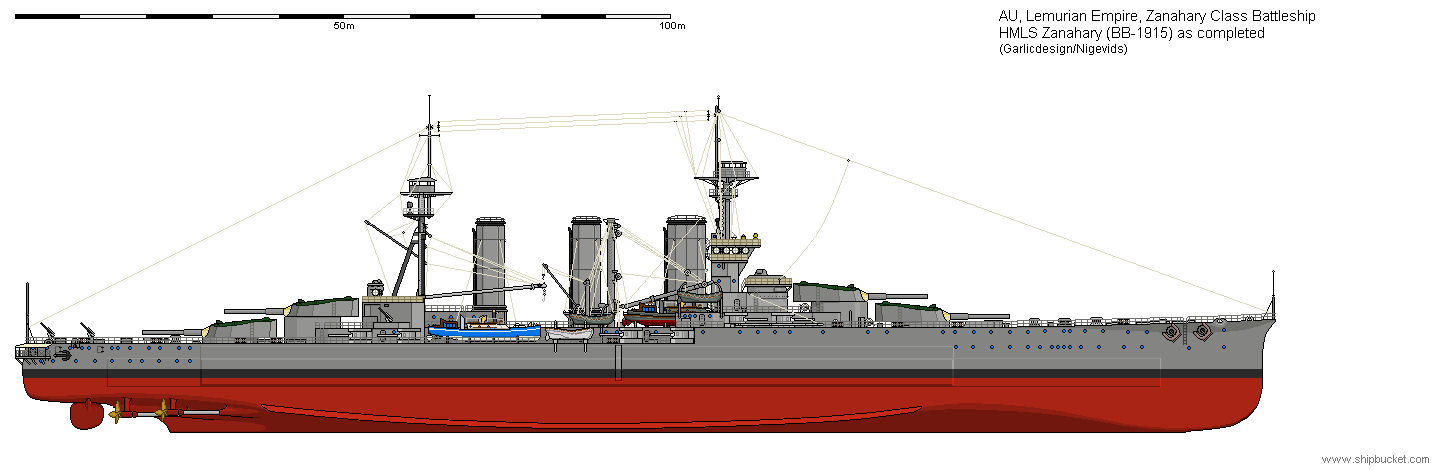
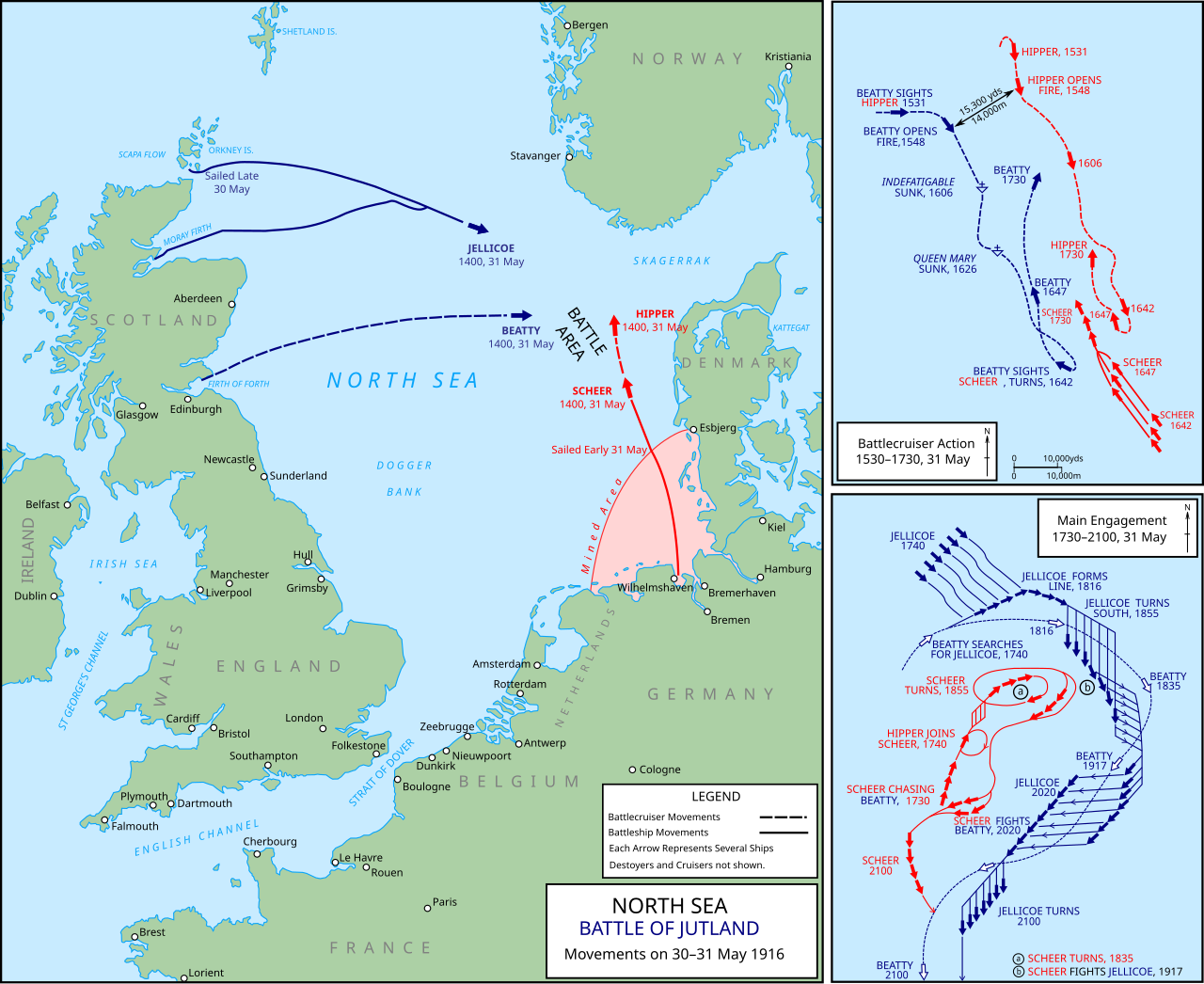
The two Zanahary class were laid down in 1912 and were completed in February and August 1915. Both went to Gallipoli where they relieved Royal Navy ships that returned to Scapa Flow to increase the margin over the German Fleet. Once both ships had joined the Fleet at Imbros and worked up together they were then transferred to the 5th Battle Squadron where they arrived at Scapa Flow in February 1916. The pair went on two Grand Fleet workups where the 5th Battle Squadron was used as the fast wing of the Fleet in a position where it could use its extra speed to run down to any problem area and give support. Late April and the third Battlecruiser Squadron is transferred to the Grand Fleet for training and gunnery purposes. The 5th Battle squadron is transferred to Beatty's battlecruiser fleet, at Rosyth, as replacements. 24th May, the Queen Elizabeth and Valiant go into drydock for boiler cleans and crew leave. Jutland. The Germans are at sea. Beatty, as always, goes roaring off with the Battlecruisers, 3-4 knots faster than the 5th Battle Squadron, leaving Admiral Evan-Thomas to try to cut corners to stay close to the battlecruisers. Evan-Thomas was sure Beatty would get into trouble. Which is what happened, Beatty attacks the German Battlecruisers under Hipper only to have two of his ships explode and sink during the first engagement. The 5th Battle Squadron saves Beatty's bacon fighting off the German Battlecruisers inflicting terminal damage on the Lutzow and damaging the rest. What saved Hipper was the appearance of Admiral Scheer and the High Seas Fleet. The 5th Battle Squadron fought the lead squadrons of Scheers ships until Admiral Jellicoe made his timely entrance and the tables turned yet again. The two Lemurian ships fired at anything they could see. Hippers battlecruisers then Scheers dreadnoughts. They received some splinter damage and that was it.
Both sides claimed victory. The Germans because they had sunk more ships. But their ships had received so much damage that they could not have fielded a similar fleet for another six months. The Royal Navy could absorb all of those losses, go back to port, re-arm and provision and was ready to fight again. In the following six months, many more dreadnoughts were added to the fleet, Germany would be even worse off. As the papers said "The German Fleet assaulted their jailers only to have the door of their prison firmly shut". On the other side Admiral Jellicoe was the only person on either side who could have lost the war for their country. Instead of receiving the praise his actions deserved, Admiral Jellicoe was made the scapegoat and the peoples darling, Beatty, received the accolades.
The two ships returned to Donbon in early 1919 and became the core of the 1st Battle Squadron. They would be joined in 1920 by the biggest ship yet built by Lemuria. The deployment of the Fleet during the 1920's was a Queen Rangita class battleship in the Mozambique Channel and the other in the Palk Strait. Then the main fleet of three battleships and a battlecruiser were based at Donbon. The two converted armoured cruisers to CVL's were positioned with the two Queen Rangita class north and south. This was the state of play through to 1934 when the two Zanahary class ships were slated for rebuilding. The three main areas to be addressed were deck and underwater protection, a modern AA armament, and most of all updated command and control functions, for all the old and new weaponry.
.png)
The Zanahary went to the dockyard in 1934, the Queen Ranavalona in 1936. The above drawing depicts the ships after their 1941 refit where Radar and other gunnery aids were fitted. Both ships were fully involved in the early parts of World War Two. First in the South Atlantic fighting the Argentinian and German forces, then they were transferred to Admiral Cunningham's Mediterranean Fleet based at Alexandria, in July 1940.