1930 and the Japanese fail to ratify the latest Naval Treaty. The gloves are off. The Lemurian Navy already had plans in place for a new pair of battleships to replace the Queen Rangita class ships. Those designs were based on the 35,000 ton restrictions then in place. To cancel those and redesign to a 40-45,000 ton ship would add another couple of years to the building process, at least. Go ahead with the two in the can and they would likely complete in 1935. Otherwise new ships may not arrive till 1938-39.
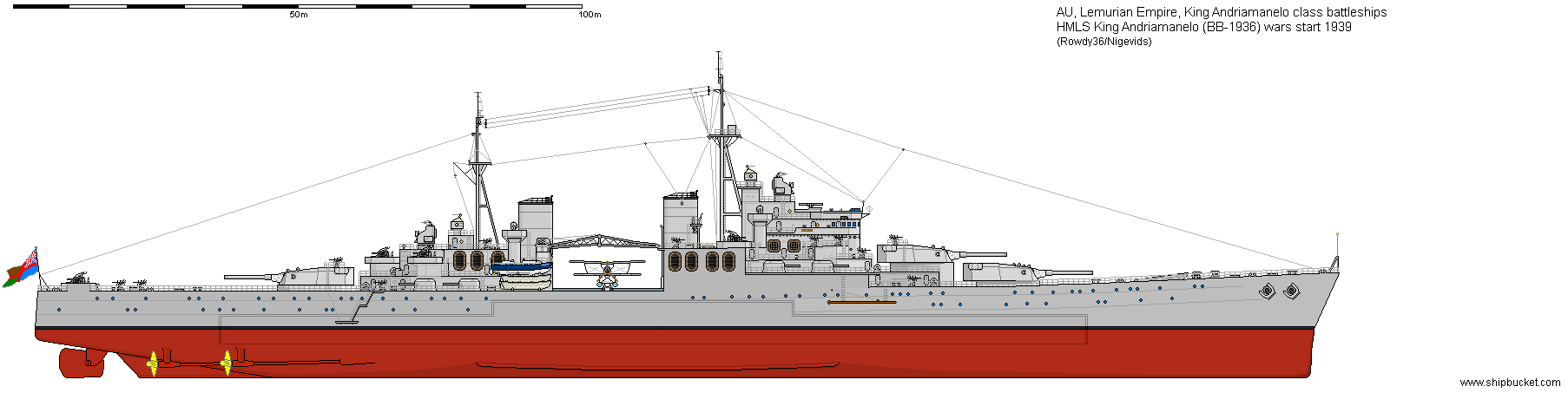
The new design carried the same Mk.1 15" as mounted on the King Ralambo but in a new turret with higher elevation and faster training and raising and lowering of the guns. Just as important, the guns could be loaded at any angle of training or elevation. A great saving in time. What all of that did was to raise the range from 29,000 yards to 36,000 yards.
The King Andriamanelo and King Andrianjaka were sent to South Africa, on the outbreak of war, to assist with the resolution of the Argentinian question. Once Argentina surrendered and the Germanic States ships in the South Atlantic had been sunk (Battle of Tristan da Cunha), the two ships were sent North to join the Home Fleet at Scapa Flow. The King Andriamanelo and King Andrianjaka spent their war with the Home Fleet fighting against the Germanic States ships. Both ships went through various refit upgrading the AA battery and mostly the Radar equipment. Because it had so few aircraft carriers, the aircraft handling facilities on these ships were kept throughout their service lives.
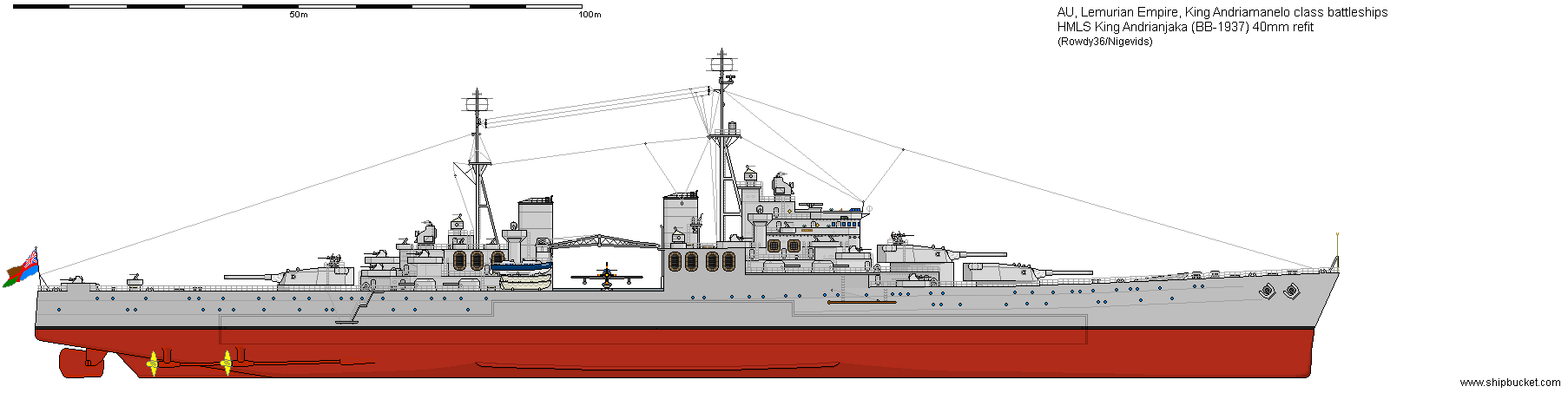
The ships highlight was the Fleet battles against the Germans. The Battle of Denmark Strait 10/08/1941 in this battle the two Lemurian ships replace the Battlecruiser Glorious of Spanish descent. Both receive heavy damage in action with the German monsters. When it came their turn to have their damage repaired, the two ships went through what I term the 40mm refit, with all the 2pd and 20mm guns being replaced with 40mm and predictors.
The two ships returned to Lemuria in June of 1945. There they joined the main Fleet at Donbon which once assembled would join other Commonwealth Forces to form the Commonwealth Pacific Fleet to help finish off the Japanese. Quite frankly the Americans did not really want them. They had done well against the Japanese and had a score to settle with them over Pearl Harbour. But the deal was done and the Commonwealth Fleet was given the South China Sea and north to clear of Japanese units. Various battles took place as the huge Commonwealth contingent wiped out anything remotely Japanese. The several Marine battalions with the Fleet cleared the smaller Islands of any Japanese troops. It was scorched earth time. The Commonwealth forces had reached the point where Okinawa was the next step when the US forces, on order of President Harry Truman, dropped the two atomic bombs on Nagasaki and Hiroshima, ending the war. The King Andrianjaka was the Lemurian representative in Tokyo Bay to watch, and the now Fleet Admiral Kanaka would sign, the surrender documents on behalf of Lemuria.