The pair of Nedunjeliyan class cruisers were essentially repeats of the previous King class cruisers, but the secondary armament was increased from 4" to the new twin 4.5" Dual Purpose weapon system. This change required quite a jump in size as the twin 4.5" required a lot more space for the turrets and magazines. While still supposedly restricted by the 10,000 ton limit, a little bit of extra tonnage was needed to be stolen to design the 4.5" into the ships. Then 1930 came and the abrogation of the treaties meant the two ships could increase in size legally.
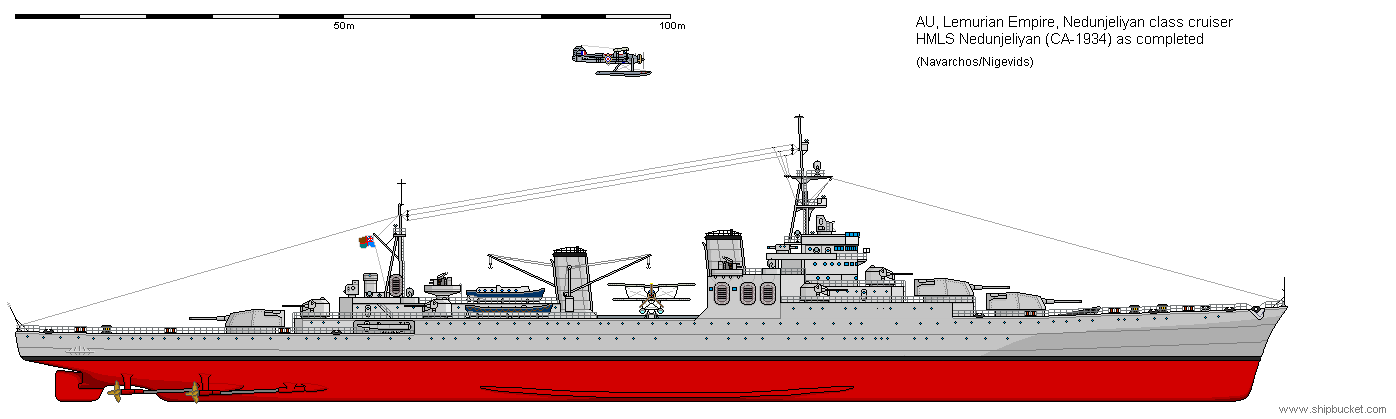
The extra firepower provided by the 4.5" battery made itself felt once the guns got to the 20,000 yard range. Engaging shipping within that range gave the fast firing 4.5" the chance to score hits on lesser protected areas of a ship and knock them out. "Sweeping the decks" was the phrase one Captain of the Analamanga used. In an engagement with another cruiser the Analamanga's 8" tore chunks out of the ship while the 4.5" knocked out the directors, secondary & tertiary armaments, and torpedo mountings. The jump from 4" secondaries to 4.5" doesn't sound much, but the 4" fired a 32 pound shell where the 4.5" fire a 54 pound shell. An increase of over 50% in destructive firepower. No contest.
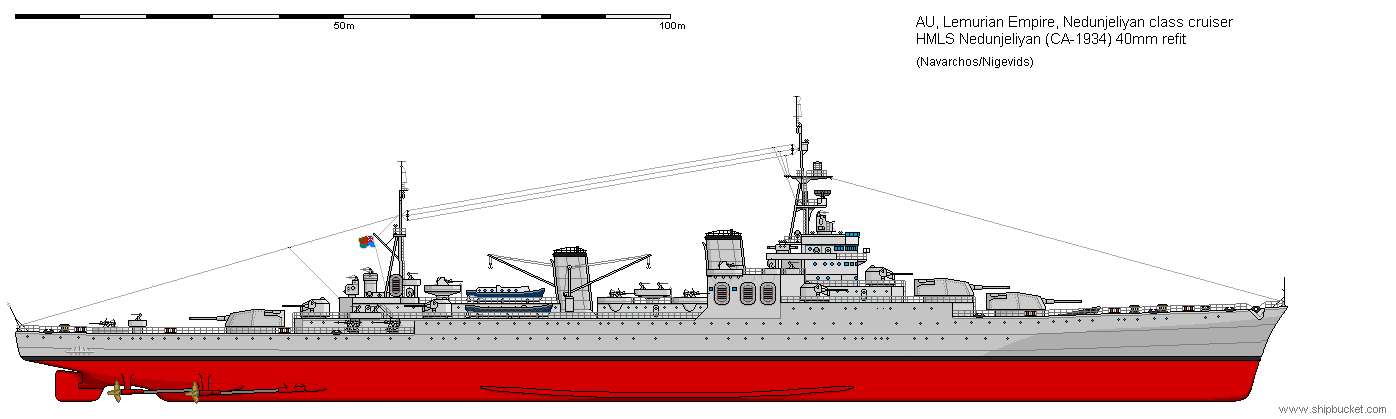
The two ships went through the 1930's pretty much unchanged. The advent of electronic aids was coming in and these ships received gunnery predictors for the main armament in 1938. The main radar and electronics suite was fitted during refits between 1940 to 1943. Upgrades to equipment continued through the lives of the ships. First armament change was the addition of 20mm guns during 1940-41. Then the whole AA armament started being replaced with 40mm Bofors guns. By the end of 1943 all of the 2 pounder and 20mm had been replaced with twin and single 40mm. Any ship heading for the Pacific Theater needed this upgrade. The 2 pounder and 20mm had proved inadequate at knocking down Kamikazes before they hit the shipping they were aiming for.
The Analamanga was serving with the Eastern Mediterannean Fleet when it came into contact with a Galician Moldova type light cruiser that was being transferred from the Adriatic to the Black Sea. The Analamanga was in the perfect position to intercept the faster ship, and with better electronics, had been able to detect the ship beyond the Moldova's sight range. Once battle was joined it would be up to the 8" to damage the Moldova's machinery to slow it down enough where it could not escape. The Analamanga launched two aircraft for spotting support and to interfere with any aircraft the Moldova might launch. The stage was set.
The Captain of the Moldova received the report, "ship to the north". "Identify as soon as possible please" was his response. He thought about the useless aircraft on its catapult aft. He had been told it was grounded with more engine problems. He would request a replacement once they got to Constanta. Another few minutes passed with the ships closing each other. An unease crept up the Captains spine when the next report gave the ship as a large cruiser. He was about to order the course to be reversed, when he was distracted by the report "aircraft to starboard", the natural curiousity had the Captain turn and raise his glasses for a look. The foremast lookout reported, "they have Lemurian markings". Oh shit the Captain thought. Knowing it was already useless he ordered a 180 degree course change. Why was it useless? Because the time taken for the course change then the increase in speed to full would allow the Analamanga well within range of those 8" guns and the Moldova would be under fire from the forward six 8" guns for some time before the Moldova's aft 5.9" would be in range. With the Analamanga's aircraft buzzing around calling the fall of shot, it was only the third salvo that the spotters called "Hit!" and the next salvo "two hits". A gout of steam and a discernible slowing of the Moldova spelt the end. The Moldova turned to face its enemy and to allow all of its main armament to bear on the Analamanga. The Captain of the Analamanga knew he had the advantage and turned to parallel the Moldova while still closing the range. The 8" guns were tasked with knocking out the main armament of the Moldova. Both ships exchanged broadsides, then the Moldova was only firing three then two turrets. The ships came within the 18,000 yard range and the 4.5" started hitting the Moldova. For the Moldova to achieve its high speed it was fitted with little armour and the 8" and 4.5" shells just blew the Moldova away. After thirty minutes the Moldova was lying on its beam ends. The 8" had been firing at the waterline and opened the internals of the Moldova to the sea. The Moldova capsized completely and went down by the bow, upside down. The Analamanga stopped and picked up survivors.
It shouldn't have done that. The Moldova had been screaming for support and a squadron of divebombers had been sent out to give aid. The time taken to pick up survivors meant the Analamanga was still in the battle area when the aircraft arrived. They could see the flotsam and jetsam of a sunken ship. Heading south the commander quickly saw the Analamanga in the distance. A single ship. The Commander smiled. This should be easy. A dozen dive bombers could be broken into two groups, one attacking from the stern and one from the broadside. No matter which way the ship tried to evade a group of aircraft would be there. The Analamanga twisted and turned trying evasive maneuvers but the aircraft had their revenge for the Moldova. Four 1,000 pound bomb hits were enough to cripple the Analamanga which lay stopped in the water, its machinery rooms gutted by two hits and down by the bow where the other two hits had opened the bow to the sea. The only question left for the Analamanga was whether an Allied ship would get there to take survivors off the ship and then sink the hulk, or whether the Axis aircraft would find the hulk and finish it off. Night saved the Analamanga. Axis aircraft did not get there in time and despite dropping a few flares to try to find the Analamanga it escaped the aircraft. Two Allied destroyers turned up and spoke to the Analamanga's Captain who stated that the Analamanga was beyond salvage. The survivors should be taken off the ship and the wreck torpedoed and sunk. So ended the Analamanga's service.
The Nedunjeliyan soldiered on and having had its 40mm refit in 1943 went to join the Allied Pacific Fleet for the fight against the Japanese. Like most large cruisers and Capital ships of that time, the Nedunjeliyan spent most of its time watching aircraft fly on and off the aircraft carriers. Things would get exciting when the Japanese air attacks were made on the Fleet. The Nedunjeliyan was never a target for the bombers or Kamikazes, and even when it was used as broadside cover for the carriers (putting the ship between the Kamikazes and the carriers), no attacks were made on the Fleet. A job that was shared around all of the cruisers and capital ships. The carriers were to be protected at all costs. The war ended and the Nedunjeliyan was used to repatriate Lemurian troops from the Philippines back to Lemur. Where other ships went into the reserve fleet the Nedunjeliyan carried on as a Flagship for light forces. The Nedunjeliyan's last active deployment was to Korea where it joined one of the Bombardment groups shelling North Korean coastal targets. That was it for the Nedunjeliyan, on its return to Lemur in 1953 the 19 year old cruiser joined the Reserve Fleet. Three years later the ship was struck from the Navy List and sold for scrap.