The abrogation of the Naval Treaties in 1930 gave the Lemurian Navy a chance to look at its current Fleet and what it would need to build to replace those ships that would soon hit the 25 year mark at which stage the ships would be looked at for retirement or repurposing. For the cruiser stocks, since the war, only the light cruiser Vatovavy and the two King class had been built. Two Nedunjeliyan Class heavy cruisers had just been ordered. A new class of light cruiser would be needed to replace the Alaotra class while the Thorombe class would be coming up to its use by dates 1940 onwards. With the two heavy cruisers being ordered and more projected to be built after the King Class, whatever light cruiser type was to be built would have to fit within the Navy's budget constraints. So the next part of the plan was to work out what type of cruiser would be best.
To aid production, one single hull would provide the basis for two cruiser types. The first being a patrol cruiser armed with 6x6", aircraft and torpedoes. The other would be an AA cruiser for Fleet work with 10x4.5", lots of smaller AA and torpedoes. The two classes would introduce the first 20mm Hispano Suiza cannons. These were not as good as the later Oerlikon. They would be slightly larger than the Thorombe, and slightly smaller than the Vatovavy. The experience with the Vatovavy had proved extremely useful. The experimental hull shape had proved a winner and was expanded for the King class heavy cruisers, and would be incorporated into the new light cruiser designs. The two large funnels showed what the ships were also designed for, high speed. This would allow them to act as Flotilla Cruisers to the destroyer units.
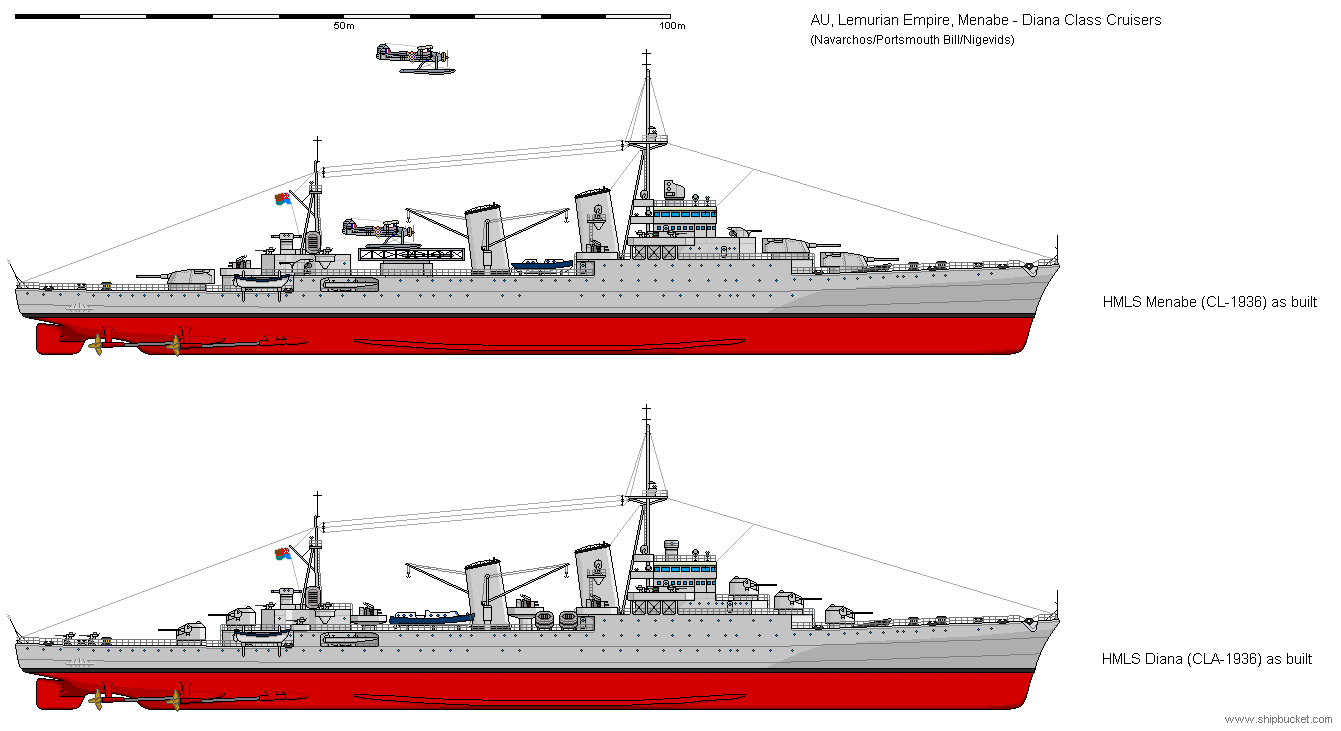
The money for the first one of each sub-class was approved in 1932 with completion slated for 1936. Further orders were placed for a pair of each in 1934 and 1936 with a last pair in 1937. Those ships would be completed in 1937, 1939 and 1940. Five of each type had been completed at wars start. Three of the AA type went south with the two new carriers to settle the Argentinians. The other two went as reinforcements to the fleet units sent to the Mediterannean. Those units sent to the Med allowed Royal Navy units to pass through the Med to Gibraltar and on to United Kingdom destinations to help guard against a Germanic States Navy breakout. After the Fall of France and the entry of Italy, Spain and Galicia into the war on the Axis side, that was no longer possible. Everything from then till 1943 had to go round the bottom of Africa.
Four of the Menabe type were sent to join Force H where they would operate as Squadron mates to the two King class heavy cruisers also in Force H. The other two joined the Vatovavy as the search units in the Indian and Pacific Oceans chasing German, Italian, and Japanese raiders. With all of these confirmed as being cleared by the end of 1942, the three ships returned to Lemur where they joined the newly completed battleship Vazimba
and acted as the Cruiser Squadron escorting the Vazimba to be the Fleet Flagship for the Eastern Mediterannean. The two Menabe type then became Leaders to the 9th and 10th destroyer Squadrons based on Alexandria.
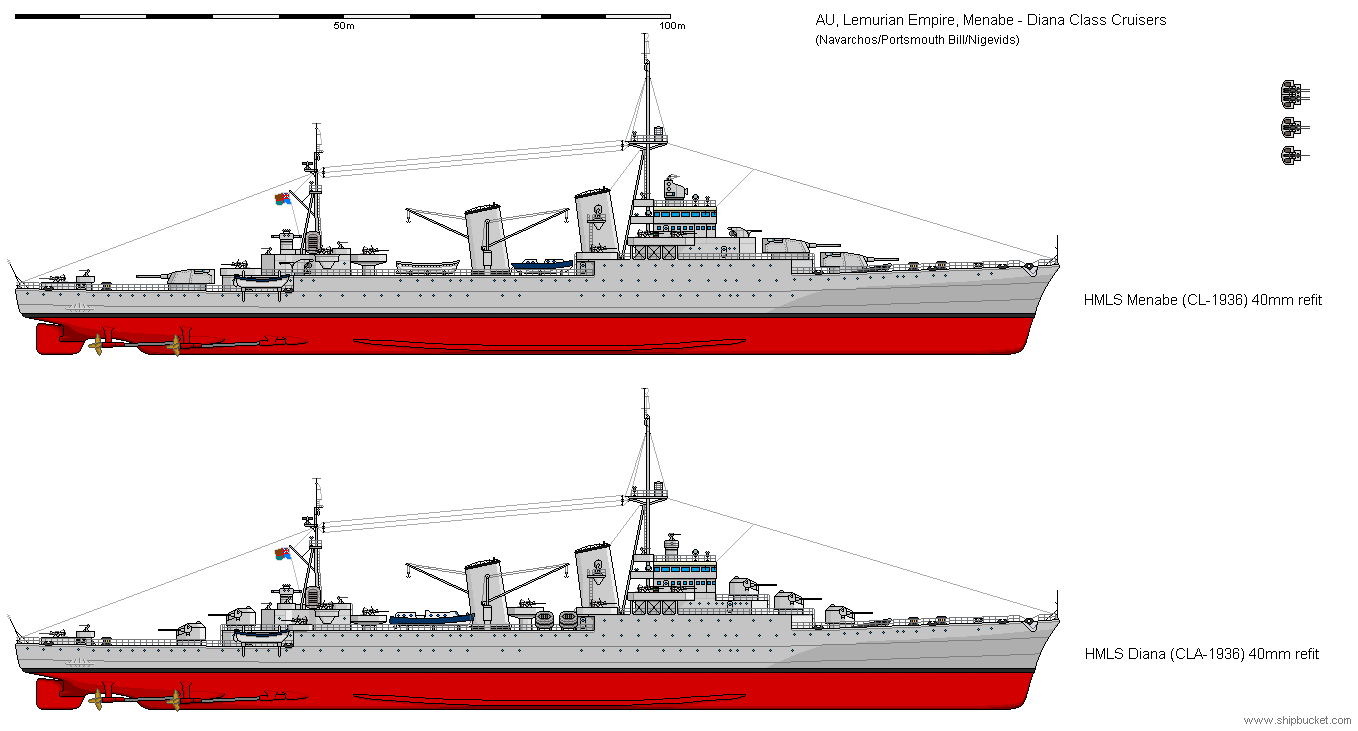
The two types went through many refits adding and subtracting different bits of armaments and electronics. It wasn't till 1943 when all of the ships had completed their 40mm refits that the two sub-classes became similar in their armament and electronic outfits. During this, both types lost their torpedoes to weight saving requirements, and the Menabe type lost their aircraft to additional AA weaponry. Radar had become so good that aircraft on minor vessels were excess to requirements.
I have left the overhead single, twin, and quad 40mm drawings to show that while they are much different in the overhead shot they are identical when viewed from the side. So I then have to remember what denomination I have placed where. The main tip to that is the size of the 'gun tub' I have placed the weapons in.
So what do I do with a dozen small cruisers. At least three should be lost to enemy action, maybe four, or five. Decisions, decisions. The Med and actions therein killed plenty of cruisers from both sides. The Atlantic convoys and the Russian convoys killed dozens more. The early battles around South East Asia and the Pacific killed many more. Finding somewhere to sink cruisers is not difficult. Sinking them in an acceptable way requires a bit more thought. I like Fritz-X, one or two hits and any cruiser becomes a note in history. Torpedoed by submarine, aircraft or other ships is another way to go. Aircraft would sink many more. Mines are another way to sink any size of ship. Lastly, natural hazards. Rocks, reefs, icebergs, all are lethal to what are essentially tin cans. The last thing I can think of is other ships running into yours. The Curacao went under the forefoot of the Queen Mary, over half the crew were lost as the ship was sliced in half.
The further a ship made it into the war, the greater its chances of survival. The first three years of the war were brutal. The Commonwealth forces took a battering. Coming to grips with the new face of war and the impact of aircraft. While I have made the Allied forces bigger, I have also increased the Axis forces considerably to compensate. The Battleship Admirals had to rethink their stance, and change or be replaced and retire to convoy duty as Commodores (simplified end - most were just retired - put out to graze). New commanding officers came and made names for themselves, carving out careers that look like something out of a 90 minute movie. The names Vian, and Harwood are worth following. Both were involved in the Graf Spee affair. Harwood in its sinking and Vian with its supply ship Altmark. Both were senior Captains at the time and ended the war as senior Admirals. Not bad for six years service.
Looks like I have managed to avoid writing up 12 war service careers, and what would they get up to after the war. The ships would not last much past 1960 as they were too small to convert for missiles. Some may last a few years longer as Lemur always needed patrol ships around the thousands of miles of coastline. Some may have been sold overseas during the late 1940's to mid 1950's, after that they would be too old.