The Royal Navy was always short of cruisers. Escort, Patrol, AA, general purpose ships, all different types of cruiser were required by the Empire to keep the seaways safe for its commercial traffic. When you have the largest mercantile fleet in the world, it is worth spending some money to keep it safe. To this end the Royal Navy invested money into various classes of merchant ship so that they would be able to be converted into useful vessels in time of war. Aircraft Carriers, AA Cruisers, Merchant Cruisers, and patrol cruisers of the Castle Class.
.png)
The investment took the shape of having the design, with space already provided, for the armament, built in. The armament to be fitted was already in warehouses. The 7.5" single mountings came from the Frobisher class that had been cancelled at the end of WW1. Single 4" AA were always available during the mid to late 1930's and four of them would be the heavy AA battery. From 1930, space was provided, in the conversion design, for a pair of quad 2pdr pom pom's. Once the ships started being converted in 1939-40, single 20mm and 2pdr were fitted. Whatever was available. In this guise the newly completed ships hit the waterways of Empire. Most went to the 10th Cruiser Squadron as patrol cruisers in the gaps that provided entry into the North Atlantic. They would be paired with a regular Fleet cruiser and guard the Straits.
It was during this phase that two of the class were lost to enemy action. Fryeburg Castle was lost when dueling with a Hipper Class cruiser trying to pass through the Denmark Strait at high speed. The Fryeburg Castle hit the Hipper several times and forced the ship to return to Norway. The damage received from the 8.2" guns of the Hipper was terminal and its team mate (a Town class cruiser) arrived in time to rescue the survivors from the ship, the hulk being torpedoed and sunk by the Falmouth. The Falmouth was unable to catch the Hipper before it made it to the safety of Norwegian waters.
The second loss was the Napier Castle which had the unfortunate luck to run into the Admiral Von Roon sneaking through the Faeroes - Shetland Gap, when it was returning to Scapa Flow from patrol. The action took an even shorter time than poor Fryeburg Castle's end. Half a dozen 12" hits and the Napier Castle was afire from end to end. To make matters worse the Roon had managed to 'maintain the range' where it could hit with its main guns and the Napier Castle could not. The Napier Castle did its job and forced the Roon to withdraw as its presence was broadcast to the world.
The loss of two ships from the 10th Cruiser Squadron in just a few months, caused a re-think at the Admiralty. Just to point out to them that the original concept for the ships was as long range patrol cruisers to catch and dispatch German merchant raiders was to point out how stupid they had been. Add Rawalipindi and Jervis Bay to the losses and the Admiralties 10th Cruiser Squadrons usage came under harsh scrutiny. Of the six ships left, three would go into the South Atlantic and Indian Ocean as raider hunters. The other three were sent back to the dockyards for conversion to AA ships and Convoy Commodore vessels. This was fairly simple with the single 7.5" being replaced with twin Mk.XVI 4" mountings. The large gun director on the fore bridge was replaced with an updated Dual-Purpose one. The aircraft handling facilities were removed at the beginning of 1943 when the proliferation of Escort Carriers made them obsolete. The aircraft were replaced with quad 40mm in a tub. The quad 2pdr were replaced, at this time, with twin 40mm.
Two of these ships were lost on the convoys they were escorting. The Germans worked out fairly quickly that these ships were the aircraft direction ships for the convoy and that sinking them would be a priority in any convoy they were escorting. The Ashburton Castle was escorting a convoy in mid-Atlantic when it was attacked by four FW-200 Condors. The Escort Carrier launched its Martlet fighters to intercept. Before the fighters could get to grips with the Condors they bombed the Escort Carrier and the Ashburton Castle. The escort carrier received one hit and fought fires for several hours before the flight deck could become operational again. Those aircraft in the air could not be recovered and had to pancake alongside an escort where hopefully the aircrew could be recovered. The Ashburton Castle received two hits, one forward that destroyed the bridge and blew the tripod mast overboard with all of its radar aerials. The other hit went through the engine room and exploded against the bottom of the ship. Uncontrollable flooding started and ended with the ship capsizing. Three Condors were shot down, one to the escorts and the other two to the fighters.
Late 1943 and the Gisborne Castle is escorting a convoy to Gibraltar when a flight of Dornier Do-217 (with JU-88 fighter escorts) aircraft attacked the major ships of the convoy escort with Fritz-X guided bombs. This was the first time the Gisborne Castle had encountered the Fritz-X and how it was used. By the time it was worked out what was happening and aircraft were sent to intercept four of the six targets, four were hit. One tanker fireballed and sank quickly. One light cruiser was hit and reeled out of the convoy with its bows blown off and only a 50/50 chance of survival. It didn't survive, a U-boat found it and a torpedo hit sent the ship down. The escort carrier was hit and sunk. Its aviation fuels tanks split and avgas poured throughout the hangar where it exploded, blasting the elevators out of the ship and splitting the flight deck down the middle. The crew was taken off and the wreck sunk. The last hit was on the Gisborne Castle and exploded amongst the rear magazines for the 4", the resulting explosions broke the ship in half. The rear sank quickly, the bow section stayed afloat long enough for the crew to be taken off. One of these was the ships Captain/Convoy Commodore, his after action report was taken seriously of the dangers of Fritz-X, but only a few days later the Italian battleship Roma was also sunk by Fritz-X and countermeasures had to be found, quickly.
.png)
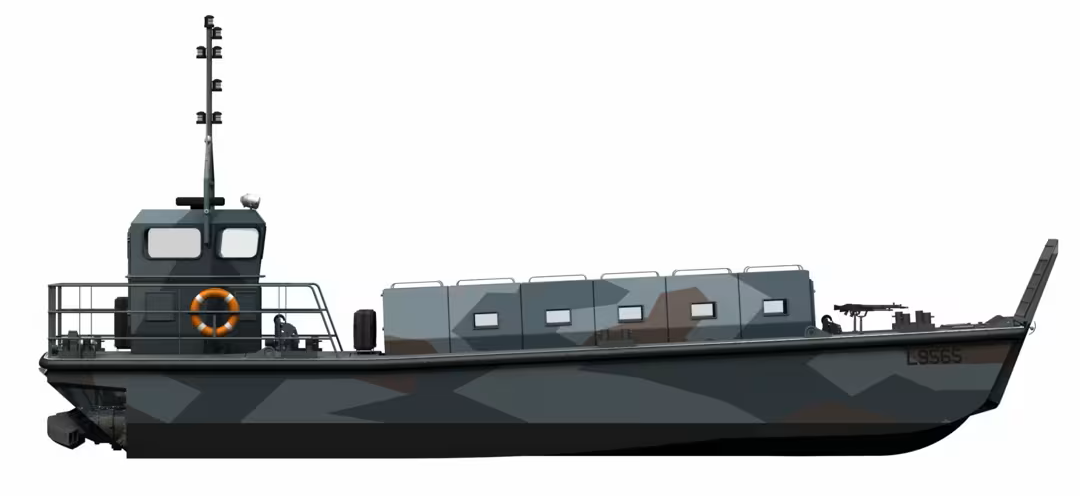
The Hamilton Castle had been in the Pacific hunting the Japanese raiders when it was decided the ship would be repurposed as an assault ship. This would be to retake the small Islands held by the Japanese with small Garrisons. To do this, the forward 7.5" would be kept as fire support weapons while the aft armament and aircraft facilities would be removed and replaced with four Landing Craft Infantry boats.
.png)
The Hamilton Castle did so well in retaking the small Pacific Islands, that anchored the sides of the US advances through the islands, that the Japanese sent a cruiser to try and find and sink the Hamilton Castle. The Hamilton Castle did not know it was playing hide 'n' seek till a Japanese seaplane flew over. A nasty surprise. The seaplane continued to circle while the Hamilton Castle screamed for help. Anything big enough to carry a seaplane would be too much for the Hamilton Castle to handle. So it proved as the Hirado came into sight and ran down on the Hamilton Castle. The Hirado opened fire at 28,000 yards, and with the help of its spotting aircraft, started achieving hits on the Hamilton Castle. The Hamilton Castle had barely opened fire with its two guns than the battle was over as a six hit salvo roared in and blasted open the unarmoured ship. On fire and with its armament silenced the Hamilton Castle was stopped in the water awaiting the coup de grace. It did not take long to arrive as two of three 24" torpedoes fired from the Hirado hit the ship. The side blew out of the ship which rolled over and capsized.