The two turrets built as spares for the Wong Class sat in a warehouse in Singapore for nearly 20 years. Then the Taipan class were designed which were to use those same turrets. The two spares were to provide part of the armament for one of the Taipan class. But new innovations were built into the new turrets that would make the old turret less effective in comparison. Khmer decided to introduce a new type of ship to the fleet. The Monitor. The Khmer Admiralty had followed the Australis Navy and what it was building, as one of its closest potential enemies or friends. The two Echidna and Cassowary classes were both double ended Monitors with a big turret at both ends, one being armed with 12" and the other with 13.5". Something similar with a 20+ knot speed would suit Khmer very nicely. An extra pair of the Taipan type 14" turrets and guns are ordered to provide the armament for a second ship. One ship is laid down in 1936 and completed in 1938, the other would complete in 1940.
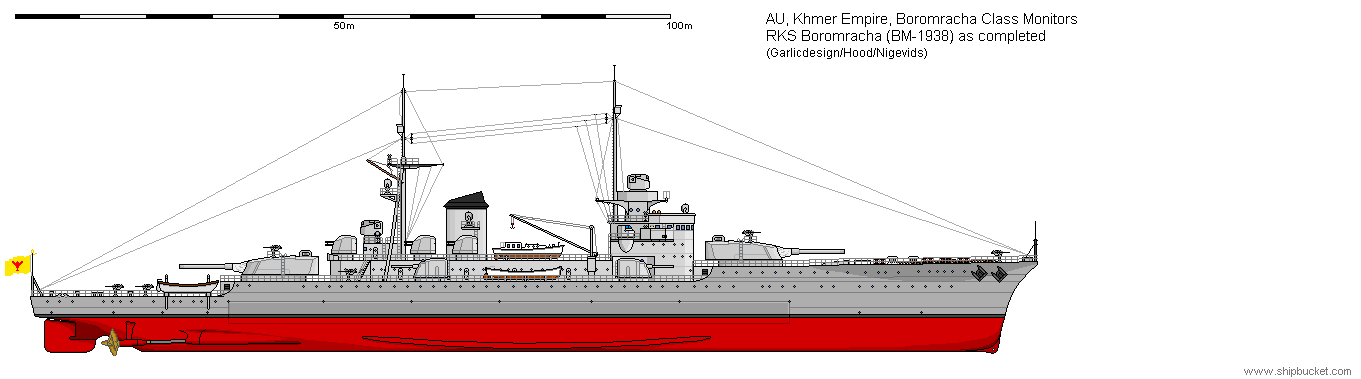
The two ships were fully engaged in suppression of piracy in the South China Sea and Indian Ocean. On completion, the Boromracha was sent to the South China Sea anti-piracy patrol. The low draught of the ship allowed it to get much closer into shore, where its big guns could range inland to strike at the pirate bases, that had kept being built further and further inland to evade the anti-piracy units. The Paknam joined the Tax Evasion Fleet based around Kedah and was used to visit the Andaman and Nicobar Islands to subdue the Pirates there.
It is during these deployments that the lack of its own aircraft facilities was felt most. To supply spotting aircraft required a further ship, or more, with aircraft handling facilities to be deployed with the monitor. Normally a cruiser sized vessel, with aircraft. One way was to remove the boats from the upper mountings and put a seaplane there. The problem with that, is there would be no catapult facility to launch the aircraft. The seaplane would have to be lowered into the sea for takeoff and landing. That would only be available for calm to moderate sea conditions. The monitor would not be able to wait off the Pirate lair waiting for conditions to be able to launch an aircraft.
December 1941 and Khmer finds itself at war with Japan. The seaward end of the Khmer line ends at the coastal fort at Vinh. The Boromracha is at Indrapura and is sent north to assist the Army. The ship did so well that the Japanese countered with Zero fighter bombers and Val dive bombers that attacked and sunk the Boromracha.
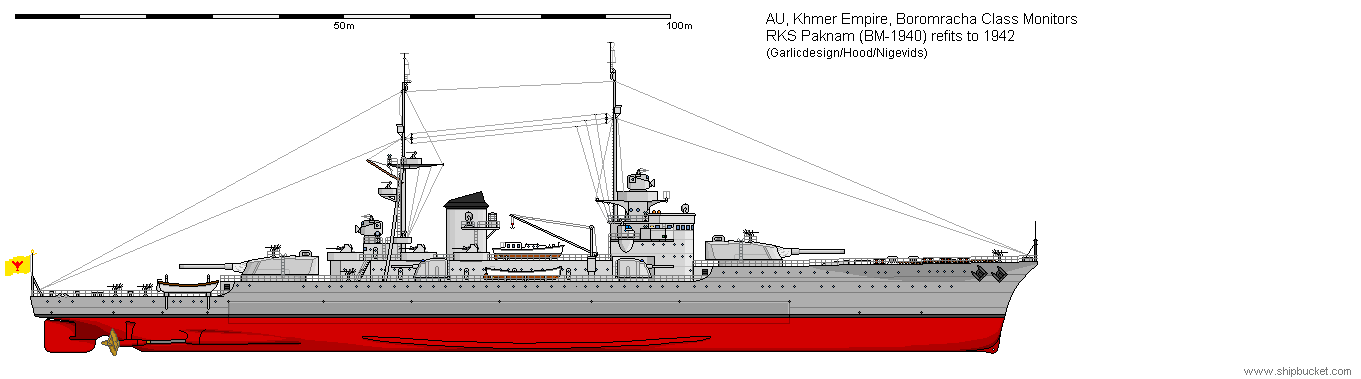
The Paknam was at Kedah on the outbreak of war and was withdrawn to Trincomalee when the Japanese Strike Force made a whirlwind advance through the South China Sea, culminating in the attack on Darwin. While at Trincomalee the Paknam received a comprehensive radar and AA package to bring the ship up to date with Commonwealth shipping. The main change was the removal of the big, heavy 40mm turrets and their replacement with quad 40mm Bofors in tubs. The 25mm were replaced with the faster firing and more accurate 20mm Oerlikons.
The Paknam rejoined the fleet in March 1942 and for the rest of the year was with the ships at Palembang escorting oil tanker convoys to the east and west.
January of 1943 and events in the Pacific had turned. Japan was on the defensive and the Allied forces were putting pressure on the Japanese outer ring. The Japanese had large garrisons on the major Islands of the Philippines Archipelago and it was the US policy to avoid those islands that had no strategic value in the defeat of Japan. The US Navy, pursuing the island hopping campaign, to get the US Air Force into bomber range, which would then reduce the effectiveness of supply and replacements for those bypassed garrisons. General Macarthur wanted to make good on his promise to the Philippino people "I will return". The Paknam joined the old battleships of the fire support group that were tasked with giving shore bombardment duties to that endeavour.
The end for the Paknam came at the Battle of the Philippines Sea where the ship was in support of the escort destroyers of Taffy 3, exchanging fire with the Yamato and Mussashi. As it was the only ship firing big guns at the Japanese force the Paknam became a priority target. Four 18" shells hit the ship which was more than the ship was designed to handle. The critical damage was the shell that hit the after turret, penetrating through to the aft magazine and removing the rear of the ship. The forward end was run ashore and was able to be used as a static firing point until the war moved outside the range of the Paknams guns. The hulk was sealed and refloated in 1946, being towed to Indrapura for scrapping.
.png)