Lemurian Empire.
Return to Fictional Navy's Page:
Return to Index page:
Go to Lemurian Navy Ship Page:
From Wiki:
Lemuria was a continent proposed in 1864 by zoologist Philip Sclater, theorized to have sunk beneath the Indian Ocean. The theory was discredited with the discovery of plate tectonics and continental drift in the 20th century. The hypothesis was proposed as an explanation for the presence of lemur fossils on Madagascar and the Indian subcontinent but not in continental Africa or the Middle East. Biologist Ernst Haeckel's suggestion in 1870 that Lemuria could be the ancestral home of humans caused the hypothesis to move beyond the scope of geology and zoogeography, ensuring its popularity outside of the framework of the scientific community.
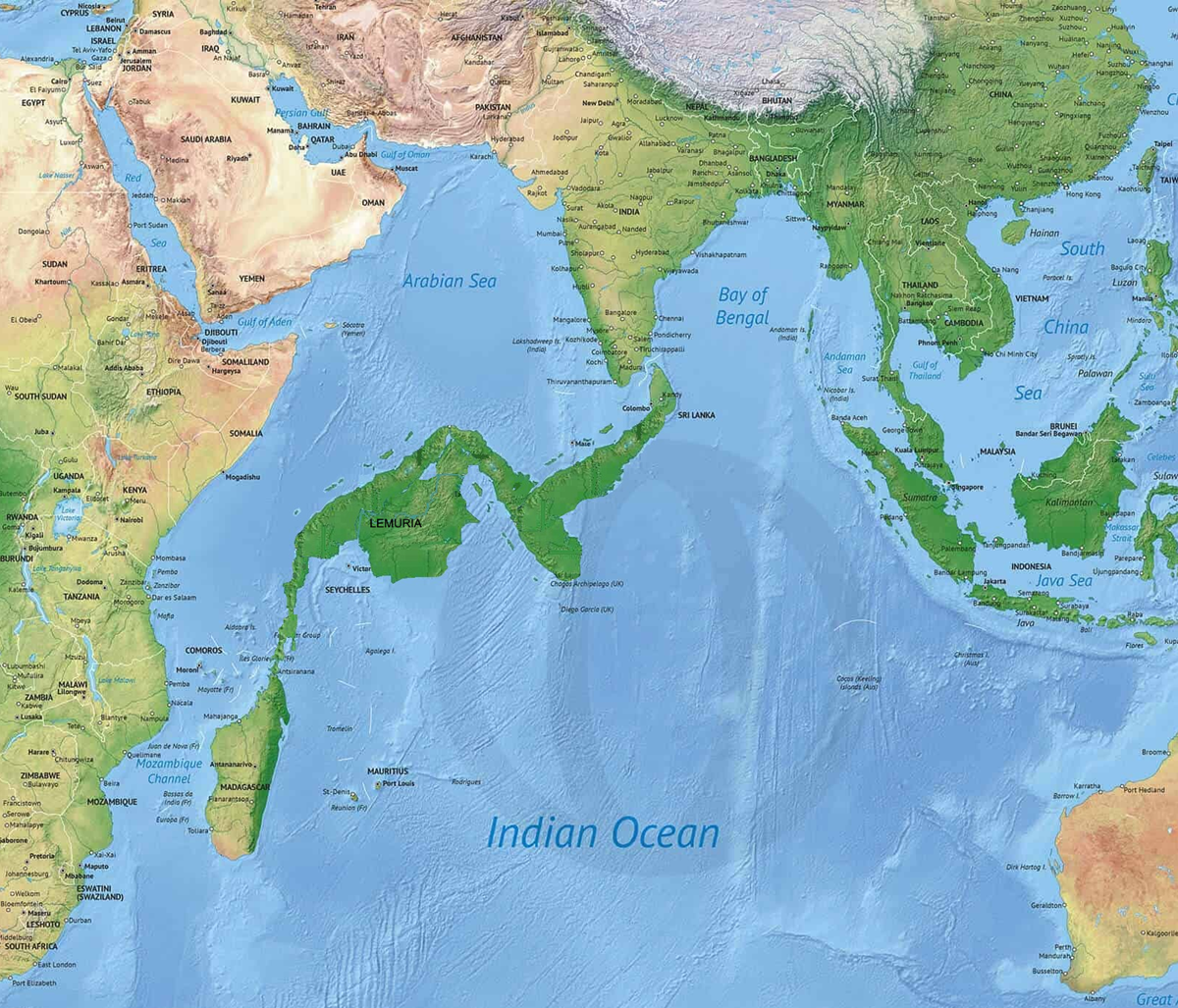
For my purposes, Lemuria creates two extra choke points for navigation around
the Indian Ocean. 1860 the Suez Canal is opened, giving better and faster access
to the East. But, those routes had to go North through the Palk Channel, between
Lemuria and India or the Southern route through the Mozambique Channel between
Lemuria and Africa. This gave whoever controlled Lemuria a greater say in what
happened in those waters. It also made Lemuria a prize worth fighting for.
Lemuria had a varied history through the ages. Human occupation started from
both ends of the lands. Asian peoples went across the Palk Strait and started
exploring the new land till they ran into the Negro peoples who had started in
the Madagascar area and slowly explored north into what would become Lemuria.
These peoples fought over the middle ground of Lemuria for centuries. A third
player arrived along the coasts of Lemuria about 200AD as the Arab dhows
explored out of the Persian Gulf, Red Sea, and Somalia. These pirates were not
averse to picking up slaves for sale in the ever ready slave markets in Europe.
Whole villages along the coasts of Lemuria would disappear into the slave
markets.
The advent of metal working and metal weapons changed the dynamics on Lemuria.
The northern Tamil Empire got these first and forced the people of the Merina
Kingdom out of central Lemuria back to their ancestral homeland in Madagascar.
The Battle of Antsiranana stopped the Tamil advance, but the Merina' did not have the
strength to push the Tamils back out of Lemuria Central. That was how the
continent remained till the European explorers arrived in the area in the 13th
and 14th centuries.
During the Crusades, the Crusaders had received intelligence of an unknown
land that was another unholy land, ripe for conversion to Christianity. Arab dhows were commandeered on the Red Sea
and a small expedition was sent out to gather more information. They never
returned. But they did actually get to Lemuria and interacted with the Asian
peoples of Central and Northern Lemuria. The efforts to promote Christianity and
convert the Tamil People led to an early grave for the group who were denounced
by the local religious people and put to death. Only two remained and they had
been kept alive by the Tamil leadership to learn what they could of these pale
skin people that thought so much of themselves. With the expedition, or any
knowledge of it, disappearing, the Crusader leadership wrote it off as a loss to
the elements and carried on to lose their war.
The next time Lemuria came into the European consciousness was when the
Portugese, Spanish, and Dutch explorers passed through the area and Lemuria
received names on the European maps/rutters (a
book of sailing directions used by mariners in the Middle Ages to navigate,
listing harbours, reefs, and tides) of
the time. This information was jealously guarded by those countries as
expeditions to this new land were put together to expand their empires and rob
the natives. The treasure that could be returned to an Empires coffers. paid for
so much of the expansion of all the military arms and the amount of land under
the Empires rule.
The European Wars between the English, French, Spanish, Portugese, Italy,
Germany and the rest, were repeated out in the colonies of Empire. The areas
controlled by those countries on Lemuria also changed hands as Governments rose
and fell in Europe.
It was not unknown in the 15th to 18th centuries that Lemuria might have four or
five different European colonies on the land. The makeup of Lemuria lent itself
to being split into smaller pieces with the southern Madagascar region, then
central Lemuria and finally the northern regions of Sri Lanka, Ceylon, and
Tamil.
The stronghold, in the south, of the Merina Kingdom was never fully subjugated
by the European invaders. The fighting abilities of these peoples were the equal
of any. Once they received European weaponry, invasion of the Merina Kingdom
required more resources than any European power could afford to have tied down
in a remote part of the world for what could be decades. Eventually an Alliance
was made with France to help provide security for the Kingdom which allowed the
French to have access to the resources under the Merina control.
The central and northern sections of Lemuria were controlled by the Tamil
Empire. This Empire had several regional governors/princes to control the lands
under the central Emperor. European intervention allowed some of these
governors/princes to make an alliance with one of the Major Powers to create a
seperate colony split off from the Empire. These colonies would fight for
control of the Empire backed by their European allies. This led to hundreds of
years of fighting between the colonies which bled the Empire dry paying for it
all.
The Great European Wars of the 19th Century finally settled the world hierarchy.
With the end of the Crimean War in the 1850's the world settled to a period of
peace, where the British Empire tightened its grip on its colonies throughout
the world. This included Lemuria. The defeat of the French in the Napoleonic
Wars allowed the British to seize French overseas colonies, this included
Madagascar and the Merina Kingdom. The various defeats of the Spanish had
allowed the British to add central Lemuria to the Empire. The Dutch, Portugese
and French all ceded their Northern Lemurian colonies to the British Empire for
one reason or another. By 1870, for the first time in its long and ancient
history, Lemuria came under the rule of one Empire. The British under Queen
Victoria.
The biggest asset Lemuria had was its hard wood forests. This wood was coveted
all over the world for numerous building projects from shipping to palaces.
Forests that had taken thousands of years to grow were cut down and milled
within decades. Thousands of square miles were taken out, leaving useless stumps
and roots behind. More decades were require for the local population to remove
the stumps to make the land into food producing ground. Slash and burn milling
ruined the land and opened these areas to all sorts of environmental disasters
never before seen. Mud slides, flash floods, all now occurred as the foliage
that had protected the land was removed.
The British survey of assets on the continent of Lemuria, showed all of the
minerals required for modern building projects. Iron and coal were in abundance
while the range of available gemstones made the Queens eyes glitter. The
forestry still available was large, but, not easy to get to. All the easy stuff
had been milled. By the turn of time into the 20th century, the easy pickings on
Lemuria had been taken and only the long term projects were left.
The fifty years of Lemurian life, from 1870-1920, saw the local Merina and Tamil
peoples reach accords for the building of much needed infrastructure to raise
Lemuria from muskets to rifles and cannons. The British may have objected to
this as they would rather see the base product be shipped to Great Britain for
processing with the resulting products then being shipped worldwide on British
shipping. But another European War was coming and the colonies would have to
fend for themselves while the British saved the world, again.
Arsenals for the production of weaponry were built in three places. Those
arsenals were built at port cities so that they could provide for both the army
and navy. Docks and shipyards were built at the same ports for the production of
ever increasing sized ships for both naval and mercantile usage. During World
War One the shipyards, while capable of building big ships, could not compete
with the speed of the shipyards of Great Britain. Thus the Lemurian shipyards
were tasked with producing destroyers and corvettes for escort service around
the Commonwealth.
The end of WW1 and the return of the escorts built during the war, showed a
major imbalance between major fleet units, cruisers and up, and smaller escorts.
Only one capital ship and three cruisers had been completed in 1914-15, those
were the ships under construction pre-war.
The make up of the population of Lemuria was very cosmopolitan as befits a
continent that has had many countries colonise parts of it. British, French,
Dutch, German, Spanish, all had major colonies on Lemuria whose populations
remained when the colony may have been absorbed into another powers zone of
control.
1920 and the Commonwealth Union is formed. The former Dominions (including
Lemuria) break away from pure allegiance to the Crown, to become self
determining Dominions of the Commonwealth Empire. The way forward for Lemuria is
in their own hands.
Ship production 1880-1914
Donbon was the major capital of the Tamil Empire. The Royal Dockyard had been on
the coast nearby for centuries. It was a shipyard that worked in wood and it was
not until the late 1800's that the shipyards started producing iron ships backed
by the foundries and arsenals that were built to aid the infrastructure required
for these new metal monsters. Similar wooden producing shipyards had been
implemented around Trincomalee (on the coast near Kandy) and at Hazamara. The
infrastructure to produce iron ships was expensive and only those three places
had that investment put into them. There were plenty of other shipyards on
Lemuria and they continued to produce the wooden ships used around the coasts of
Lemuria.

Most of the iron ships built by Lemuria from 1880-1900 were for coast defence.
The biggest ships during that time had one or two big chase guns forward with
smaller guns aft. Much like the gunboats that had been built for hundreds of
years.

The early 1900's changed the building policies for Lemuria. Great Britain now
had challengers for building the best ships. Germany, France, Italy,
Austro-Hungaria, Japan and lastly the United States. All started producing
better ships. But it was the Dreadnought race that sorted out the Great from the
wannabes. Laying down the Dreadnought had been a calculated risk. At one stroke
the Royal Navy had made its 50 pre-Dreadnoughts obsolete. All navies now started
from scratch. Whoever could get the most new battleships and battlecruisers to
sea would rule the seas.
All of the Dominions that could build battleships were tasked with producing
what they could to aid the Empire in any battle(s) against a common enemy. The
shipyards around Great Britain were building new ships so quickly that anything
being built by the Commonwealth nations was almost out of date before it was
completed. The jumps in gunpower from 12", to 13.5" then to 15" happened so fast
that only the largest of the Major powers could keep up. The Italians built half
a dozen Dreadnoughts with 12", missed the 13-14" ships entirely, designed and
laid down the 15" Caraciolo class that was never completed. The land war between
Italy and the Austro-Hungarian Empire took all the resources of both countries,
nothing was left for building Dreadnoughts.
Lemuria was able to build battleships and battlecruisers but not in the numbers
that Britain would have liked or at a production speed that would put them at
sea at a reasonable rate. Even at its fastest building rates it would take
Lemuria 4-5 years to produce a Dreadnought class warship. While Lemuria had the
resources to produce the new ships, actually mining the resources, transporting
them to where they would be transformed into the bits required from rivets to
huge guns, took them time. Working in hot conditions is the worst. In cold
conditions you can add clothing. When you are hot and already next to naked
there is nowhere to go. Production would be slowed.
The designs that arrived in Lemuria for the new ships were overly complicated
and the Lemurian designers dumbed them down for production in their shipyards.
Eight and ten gun designs were reduced to six and eight gun designs. While these
ships would still be Dreadnoughts they would not be as powerful as the
originals.
So lets see how the Lemurian designers did in producing designs they could
afford to build.