The second Dreadnought type to be built in Lemuria was one of the new Dreadnought Cruisers. These would be termed 'Battlecruisers' from 1912 onwards. Again the plans for HMS Invincible were sent out to the Dominions with the simple request 'Build!'. As with the plans for the Bellerophon that became the Queen Rangita, the Lemurian designers looked at the plans and knew they could do better with the same sized ship. The first thing noticed was that those bloody wing turrets would be more of a menace to their own ship than the enemy. The time needed to be able to traverse the guns to be able to fire on the opposite broadside was very slow. Also the very limited angle that the guns could fire at to the opposite broadside made them almost useless.
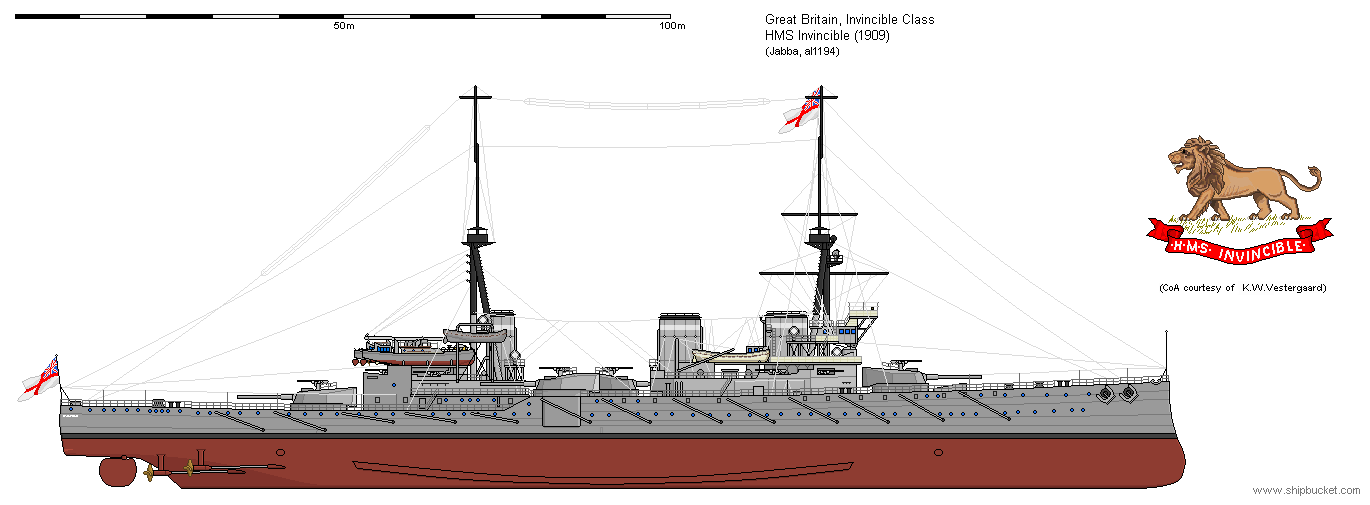
The best way to improve the ship was to remove the wing turrets and go to an inline armament similar to the Queen Rangita.
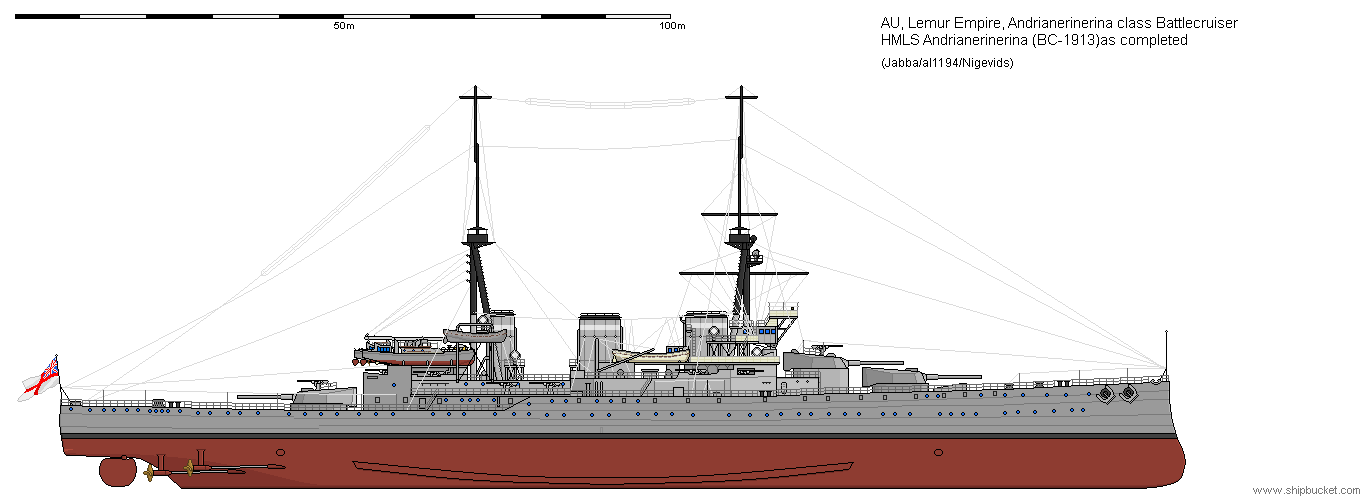
The Andrianerinerina ended up being a one ship class. It was Flagship of the 1st Cruiser Squadron which had the two armoured cruisers as its Squadron mates. While the armour level had been increased from the original 6" belt to a 9" belt the ship still felt under armoured. The increase in armour came directly from only having three turrets. The weight saved being expended in better armour. The other notable change was that the Andrianerinerina retained the 4" as its secondary battery where the Queen Rangita went to 6".
1914 the Andrianerinerina was sent north to join the fast fleet assembled at Singapore to defeat the German Asiatic Squadron (Von Spee), but it crossed the Pacific and won at Coronel only to lose at the Falkland Islands just days later. With that defeat the Andrianerinerina returned to Lemuria to be sent to the Rufiji River where a German cruiser had holed up. Thinking itself safe from destruction or capture the Konigsberg was eventually sunk at its mooring by the Andrianerinerina, which used for the first time, spotting aircraft to tell the ship where its shells were falling. Once the range and line was found, the Andrianerinerina fired salvoes until the aircraft reported "target destroyed".
That was the highlight of the Andrianerinerina's First World War service. The Andrianerinerina went to the Mediterannean with the rest of the Fleet, alternating between the Dardanelles and the Adriatic. At Wars end the ship returned to Lemuria where it became 1st Cruiser Squadron Flagship again. The only war time upgrades was the removal of the 4" on the turret tops and their replacement with 3" AA guns.
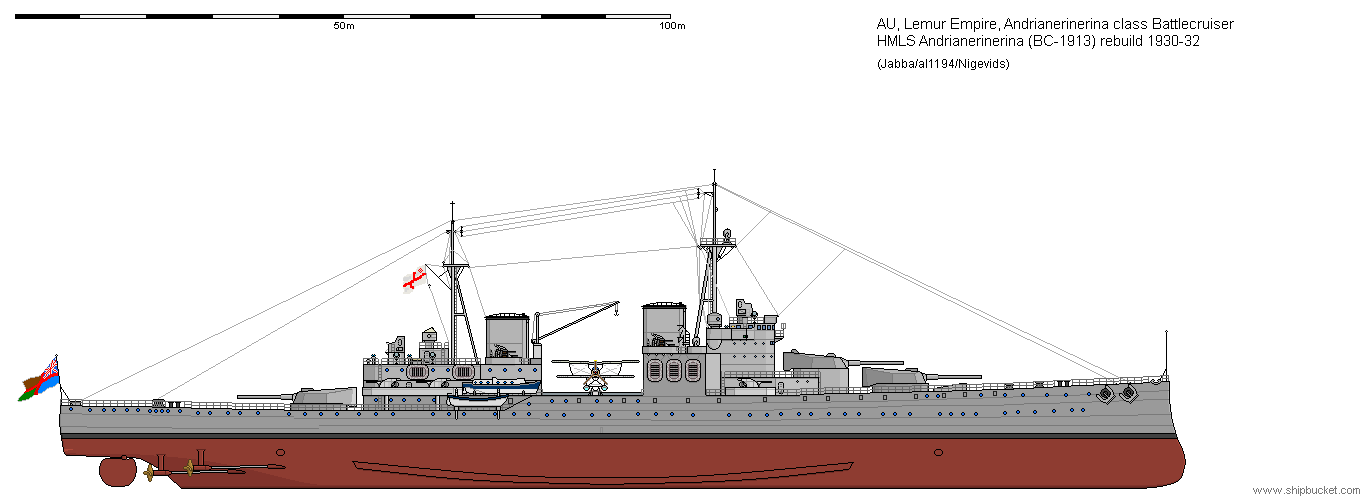
The first pair of modern heavy cruisers arrived in 1930, and joined the Andrianerinerina in the 1st Cruiser Squadron. But for the Andrianerinerina to be useful as Squadron Flagship it would need to go through a rebuild process to bring it up to standard. The rebuild was much more comprehensive than the Queen Rangita type. Command and control, AA battery, deck armour, new machinery, all would be upgraded or replaced. The refit took 3 years and completely transformed the Andrianerinerina.
October 1939 and the Andrianerinerina was on its patrol line, covering the center of the Mozambique Channel, when it received an RRR call from the Queen Rangita which was stationed to the south. A position followed then a positive ID of the raider as the Tirpitz, a converted battleship. The Queen Rangita should be a match for the Tirpitz, but the extensive modernisation of the Tirpitz included much better deck armour, while the Queen Rangita still had its original deck armour. The Queen Rangita's guns were not going to do as much damage to the Tirpitz as it would receive. The Andrianerinerina had an aircraft in the air and sent it south to help out the Queen Rangita with spotting duties. The aircraft had barely got there when it was shot down by one of the Tirpitz's Arado aircraft which were far superior to the Lemurian floatplanes.
The Andrianerinerina headed south at best speed to give assistance to the Queen Rangita which was coming north with the Tirpitz in pursuit. Ten miles to the north of the Andrianerinerina was the ship that would make the difference in the following engagement. Admiral Kanaka aboard the Andrianerinerina ordered the Karikala to range and launch an air strike against the Tirpitz A.S.A.P. The Karikala was a baby carrier with only 18 aircraft, 12 bombers and 6 fighters. The ship took nearly 40 minutes to get the strike in the air and on its way to attack the Tirpitz. During that time the Queen Rangita had been pretty much crippled but was still going north. What saved the Queen Rangita was the arrival of the Andrianerinerina which brought with it three Griffon fighters which cleared the Arados, and allowed the Andrianerinerina's spotters to have the field to themselves. The Tirpitz's gunnery got worse while the Lemurian gunnery got better. Then the air strike arrived. With eight torpedo bombers and four dive bombers, the aircraft carried out a text book attack on the Tirpitz hitting it with two torpedoes and two bombs, while the fighters cleared away the Tirpitz's light AA gunners. The air strike did enough. While the Tirpitz may have been modernised above the waterline, it still had the pre-WW1 underwater protection. The two torpedo hits blew out one boiler room, which showed in a gout of steam out of the funnel, while the boiler room started filling with water and deteriorating the ships stability. The other torpedo hit was aft in line with the aft turrets. The damage did not show but the concussion had blown the turrets off table and out of action. The Andrianerinerina put the forward turret out of action and suddenly from being in control of the battlefield the Tirpitz went to a crippled wreck. The Andrianerinerina kept firing while Admiral Kanaka watched the stability of the Tirpitz keep heeling to starboard. Admiral Kanaka ordered 'cease fire'. The Tirpitz was no longer firing and its crew were starting to abandon ship. Lemurian boats were being put into the water when the Tirpitz rolled onto its beam ends and went down. Arise Sir David Kanaka.
The Germanic States named one of its new battleships 'Tirpitz' in commemoration of the Tirpitz's fight against superior odds. (Which is how Dr Goebels termed it).