The main minelaying force for Lemuria, in 1920, were the cruisers and destroyers that had been converted for those duties. Their mine capacity was small. The Allies had been able to go over the German Bremse class minelayers before they were sold. The Bremse was a good example of what an offensive minelayer should be. Fast with a decent mine cargo deck.
At this stage, in the 1920's, the aircraft was not such a problem for minelayers. The offensive minelayer has to get to an enemy coast, lay its minefield and then get away undetected. While aircraft are bi-planes doing 120-150 mph this is still relatively easy for ships traveling 33-35 knots. But once the patrol aircraft got over the 200mph barrier, minelayers had to become faster. If a patrol aircraft spotted your minelayer leaving the scene of the crime, your enemy would know a minefield had been laid and could send sweepers out to do a bit of cleaning. An undetected field can hope that the first shipping to find it sinks, losing valuable ships and/or cargoes.
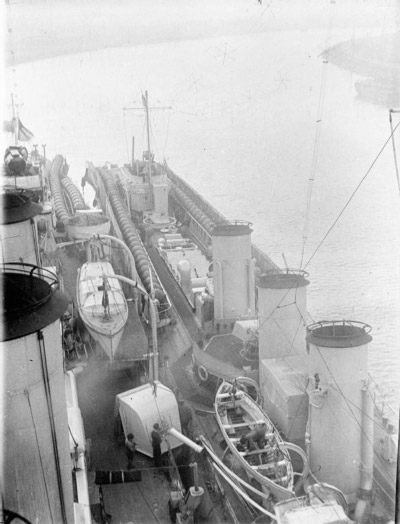
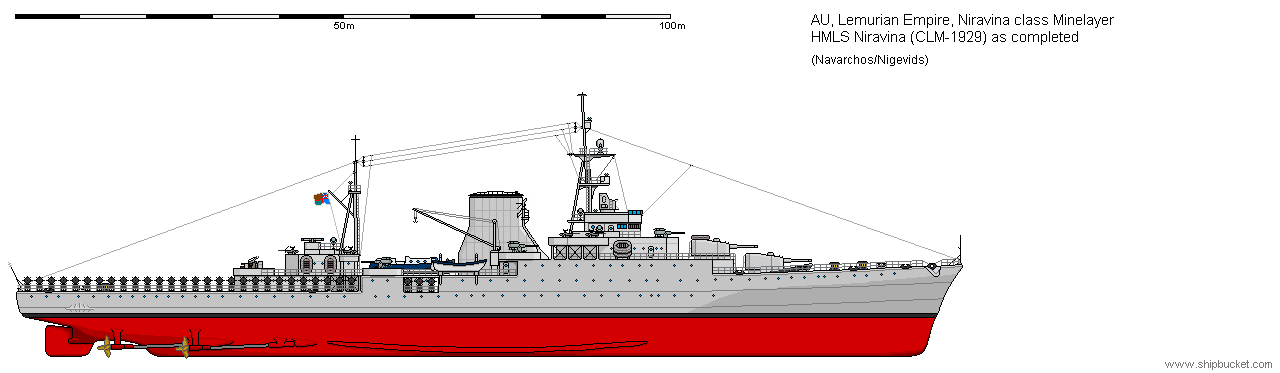
That was what the Lemurian designers went for. Fast with a good mine capacity. During the early 1920's the Lemurian's had done a lot of good testing of hull shapes to provide a hydro dynamically proficient hull. The hull would slide through the water with the least effort. More speed with less horsepower. The Vatovavy was the initial test bed for this hull type. It proved so good, it was adapted to the Niravina and a range of other light and heavy cruisers. Like a lot of shipping produced 1915-1930, by 1939 it would be obsolete. It is aircraft and the amount of ordinance that they carry, that made them obsolete. Deck protection and underwater protection was not sufficient enough to survive the latest weaponry. This included the Niravina. When it was completed in 1929 it was state of the art. !0 years later it was 5 knots or more too slow and needed a better AA armament. The AA problem could be ameliorated but the lack of speed sidelined it to secondary duties.
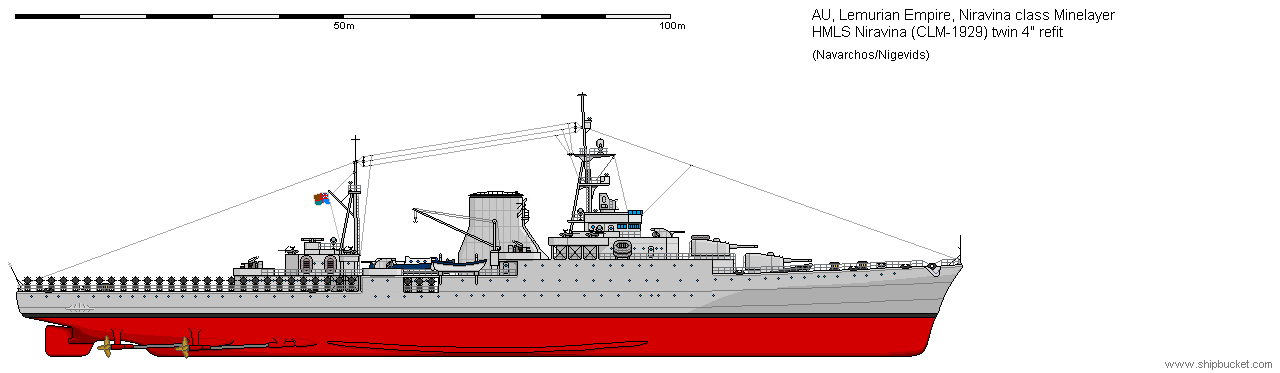
By 1938 the AA weaponry had been enhanced with replacing the five single 4" AA with three twin 4" Mk.XVI mountings. The pair of 4" beside the funnel were replaced with another pair of quad 2 pounder. At the outbreak of war the ship was still waiting for electronic upgrades. These were due in early 1940. The Niravina was quite a long way down the list of priorities for new equipment.
The Niravina's first evolution on the outbreak of war was to mine the Madagascar Strait, to deny enemy shipping access to the inland Lemurian Sea. That way shipping would be able to proceed around this area unescorted. A great saving in escort vessels that could be better used elsewhere. The Niravina had been hove to overnight from laying the minefield as accurate placement of the mines to maps and the safe passages through the field needed to be kept. Out of the dawn came a menacing black shape with the clouds and squalls surrounding it. The signalman sends "What ship?". No reply. The Captain has been called to the bridge and says "Signal again". "What ship?". No reply. The Captain orders the alert. The Tirpitz comes out of the night and smites the Niravina. Just one 12" hit and the Niravina vapourises. Too many mines on the mine deck. One unfortunate hit amongst those and the Niravina is gone. The Tirpitz does not go unpunished for long as the guard force catches and dispatches it.